Archive for the 'Diversity' Category


Love in Any Language!!

Monday, January 28th, 2008

February 14th has come to mean red and pink hearts, flowers, chocolates and Hallmark cards here in the US. But, how did Valentine’s Day become a day that we celebrate with our loved ones? Valentine’s Day began as a saint’s day commemorating Saint Valentine, a Christian martyr. The day became associated with romantic love in the High Middle Ages, when the tradition of courtly love flourished.

The day is most closely associated with the exchange of love notes in the form of “valentines.” Modern Valentine symbols include the winged Cupid and the heart. Since the 19th century, handwritten notes have largely given way to mass-produced greeting cards. The U.S. Greeting Card Association estimates that approximately one billion valentines are sent each year worldwide, making the day the second largest card-sending holiday of the year behind Christmas.

We are all familiar with the US version of the Valentine’s Celebration – but how do other cultures celebrate the Holiday?

• In the UK a character called ‘Jack’ Valentine knocks on the rear door of houses leaving sweets and presents for children.
• In Wales many people celebrate St Dwynwen’s Day on 25 January instead of, or as well as, St Valentine’s Day. The day commemorates St Dwynwen, the patron saint of Welsh lovers.
• In Finland, Valentine’s Day is called Ystävänpäivä which translates into “Friend’s day”. As the name says, this day is more about remembering your friends than your loved ones.
• In Slovenia, a proverb says that “St Valentine brings the keys of roots,” so on February 14, plants and flowers start to grow. Another proverb says “Valentin - prvi spomladin” (”Valentine — first saint of spring”), as in some places, Saint Valentine marks the beginning of spring.
• In Chinese culture, there is a counterpart to Valentine’s Day, called “The Night of Sevens”; according to legend the Cowherd and the Weaver Maid meet in Heaven on the 7th day of the 7th month of the lunar calendar.

To put a unique spin on Valentine’s Day try incorporating some of the other special traditions practiced by cultures around the world.

1. Leave a present for your child on the doorstep from Jack Valentine
2. Spend time with your friends and encourage your children to do the same. Focus on fellowship more than the feelings of love.
3. Plant flowers, trees or bushes in celebration of the coming of Spring
4. Read the story of the Night of Sevens and discuss it with your children.

Please take a minute and consider that Valentine’s can be a fun and memorable day for children, families, parents and singles alike if we look at the Holiday through a different pair of eyes.

Disney around the World!

Wednesday, January 23rd, 2008

Having just returned recently from the Happiest Place on Earth & having had a WONDERFUL experience taking our 2 year old daughter for the first time, I thought this was a great slideshow the shows the cultural sensitivity of the Disney Company & the class with which they handle themselves in all aspects of their business.

Click here to view the slideshow 

Please enjoy the slideshow & visit Disneyland when you get the opportunity - you really will feel warm and fuzzy all over when you leave :) Lisa

How to teach cultural diversity in a non-diverse community?

Monday, January 21st, 2008

In many communities across America the complaint is the same; “I want to help my children learn about other races, religions and cultures, but my community isn’t very integrated & my circle of friends is not diverse, what do I do?”  It’s true that although we are a country of diverse backgrounds, most people tend to seek out groups of friends of the same race, religion and/or ethnicity.  It is easier to find common ground and the language barrier is not present when spending time with others who share in our culture.

However, parents would like their children to be accepting and tolerant of other cultures even though they may not be exposed to them on a regular basis, what’s a parent to do?

Enter the wonderful world of children’s television programming.  With the choices our children now have, you can expose your children to multiple cultures, languages and traditions all in the same afternoon.  A new study released recently from the American Academy of Pediatrics reveals that high-quality educational programming can have a positive effect on young children. These programs assist in the acquisition of general knowledge and improve cognitive learning among children ages six and younger. The report also states that educational programming which emphasizes cultural and racial diversity can improve children’s attitudes to those subjects.

So, the television now becomes the ultimate cultural teacher & not the “boob tube” that parents once thought it to be.  The one possible drawback to this seemingly perfect answer?  There must be culturally diverse and age-appropriate shows for children to view & learn from.

Luckily for us parents searching, children’s programmers have responded.  There are any number of shows on television today featuring characters of different races, with disabilities and even those that speak different languages.  Three child-oriented stations are leading the pack with their high-quality, diverse and educational television programs.

PBS is the trailblazer in this category features Sesame Street, which has taught generations of children around the world their ABCs and how to count.  Much more than that, since the inception of the show 35 year ago, there have been racially diverse characters & characters with disabilities & they all work together to promote the overall the message of acceptance and togetherness.  Even today, there are strong female characters, multi-lingual characters that teach “words of the day,” & they have featured adopted families, non-traditional families & characters in wheelchairs all enjoying their time on 123 Sesame Street.

Nickelodeon has been the big winner in viewer share and profit with their introduction of Dora the Explorer and it’s spin off, Go Diego Go.  These educational cartoons feature multi-lingual, Hispanic characters that teach about animals, letters, numbers, counting and Hispanic traditions.  The real innovation with these programs is that they also focus on teaching Spanish to non-native speakers.  The repetition and interactive nature of the 30 minute shows make learning fun and also get children up off of the couch to participate in the actions that Dora, Diego and their friends instruct.

Nick is also launching a series in February with an Asian-American leading lady. The show, “Ni Hao, Kai Lan,” was created by a first generation Chinese American.  It targets 2- to 5-year-olds and follows bilingual five-year-old Kai-Lan as she learns about her inter-generational Chinese-American family. The curriculum focuses on social and emotional lessons, multicultural values, cause-and-effect thinking, and basic Mandarin Chinese language skills.

Finally, we have NOGGIN TV and the show, Little Bill, the everyday adventures of an African-American boy.  The show is based on Bill Cosby’s popular book series and is developed through research and in consultation with educational experts. The show is designed to help kids celebrate their everyday experiences and the people who share them. Little Bill shows kids that what they do makes a difference in the world. By dealing with conflicts encountered in everyday life, the program encourages children to value the love of their family, to increase self-esteem, and to develop social skills.

These programs are just the first in a long line of diverse and unique shows that will help our children to see that different is just different and we are no better or worse for not looking, speaking or dressing like “everyone else.”

Congratulations to PBS, Nickelodeon and Noggin TV for being innovators and addressing the need that we as parents have for teaching from the comfort of our own homes.  Nothing replaces the human interaction and relationships that are important to helping children understand cultural differences; it is still important to try to get involved and meet other families that are different from us.

In some circumstances however, that proves extremely difficult and given the choice between not exposing them to these differences at all, or spending an hour watching any of the children’s programs that were created to teach and enrich their experiences, I’m picking up the remote control.

Check out these products…

Friday, January 18th, 2008

Regionz Kidz books & clothing

PersonalChildStories.com - Who Am I and People and Trees

BarefootBooks.com (please use code EV98 when checking out)
Whole World Book & CD
Peace, Love & Vegatables Gift Box

Cookies Around the World!!!

Wednesday, December 19th, 2007

My partner Michelle at www.MagicalMeltingpot.com has many delicious multi-cultural recipes especially perfect for this time of year.  Take a look at these yummy cookies from all different parts of the world & try making some of them with your family this Holiday season!

 http://food.yahoo.com/blog/themagicalmeltingpot/1850/holiday-cookies-from-around-the-world

Tamale Traditions - Guest Blogger, Mia Hernandez

Tuesday, December 18th, 2007

This post was written for me by my good friend Mia - I asked her to talk about her family tamale-making tradition.  It is wonderful to hear how different families celebrate this time of year with their own festive and fun traditions!  Thanks Mia for your insight :)  

 In our family we have an annual tradition of holiday tamale making.  This is a long-held Mexican tradition that has been passed down for generations.  Personal to our family, there is a hierarchical work line.  It starts with the cleaning and sizing of the corn husks.  This job is saved for the least experienced tamale makers such as children, teenagers or newcomers.  This role is not taken lightly.  If you are assigned to corn husk detail, prepare yourself for endless ridicule (all in good fun of course). 

 Next, the masa is prepared and spread onto each corn husk.  The masa is made of cornmeal and lard.  The masa soldiers are in constant competition to see who can spread the masa the fastest, smoothest and heartiest onto the corn husks.  My father has proven to be the ultimate masa spreader for years.  We do our best to give him a good run for his money.  

 After the masa is spread onto the husk, the most experience member fills the center with shredded meat made of pork and chile.  This role has always been filled by my mother.  In her youth, my grandmother was the meat preparer and before her, my great-grandmother.  Our tradition began, in the mountains of northern Mexico where my great-grandmother assembled the work line.  This year my mother prepared the meat the night before, and it’s known in our family that the spice level of the meat provides evidence of the mood the meat maker was in while preparing the meat.  This year, it was evident that my mother was in a bad mood because the meat was exceptionally spicy. 

 Lastly, a family member rolls the tamales, wraps them in paper and stores them in bags.  From there, we give them away as gifts to friends and eat them on Christmas day.    Each one is a tiny little present ready to be unwrapped and served.

This is our tradition.  It is a very special time for us to set aside from our busy schedules in order to celebrate one another.

The World Says Merry Christmas!

Wednesday, December 12th, 2007

When browsing MSN yesterday I came upon this fun slide show - People around the world celebrating the Holiday season in their own unique ways! However you celebrate this wonderful time of year, make sure you take time to enjoy the wonders around you :)
click here to see the slideshow

Happy Holidays!

Thursday, December 6th, 2007

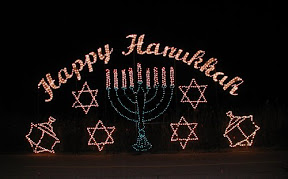
The holidays are upon us and in the melting pot of a nation that we live in today, there are many people out there celebrating many different holiday traditions. Each holiday is celebrating surrounding a different religious tradition. Some of these holidays include Christmas, Hanukkah, and Kwanzaa.

Hanukkah is celebrated for eight days, by performing a series of rituals, which started on December 4, 2007. The traditional Hanukkah greeting is “Happy Hanukkah”. Hanukkah is also known as the Festival of lights. Hanukkah can be celebrated anywhere from Late November to Early December and is the story of standing up for what you believe in. The most important of the Hanukkah rituals according to the Jewish is to light a single light each night for eight nights, with the number of lights to be lit is to increase my one every night.

There is also an extra light called Shamash, which means guard or servant and that light, is also lit each night. These lights can be candles or oil lamps. These lights should burn for at least a half hour after dark.
Three blessings are also recited during these eight days. When the candles are lit, the Hanerot Halalu Prayer is recited. Then after lighting the candles each night, but while still in site of the candles Ashkenazim sing the hymn Ma’oz Tzur. The Last day of Hanukkah is also known as Zot Hunukkah.

There are also other fun and traditions that go along with Hanukkah. Hanukkah Music is one great tradition. The most well know songs are “Dreidel, Dreidel, Dreidel” and “Chanukah, Oh Chanukah.” Some Hanukkah foods include, Potato Pancakes or fruit filled donuts, which are deep-fried in oil. And a very well known Hanukkah game played with a dreidel.

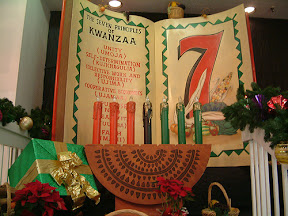
Kwanzaa is also a well-known Holiday in December. Kwanzaa is a weeklong Pan-African Festival taking place December 26th through January 1st. Kwanzaa consist of seven days of celebration including, candle-lighting, pouring of Libations, feasting and gift giving. Families celebrate by decorating their house with objects of art, colorful clothing and fresh fruit. A Kwanzaa ceremony could include drumming and musical selections, libations, and reading of the “African Pledge”, a candle-lighting ritual, artistic performances and a feast called Karamu.

Finally yet importantly is Christmas. Christmas is celebrated December 25 and is a celebration of the birth of Jesus. Christmas is also known as the exchange of gifts among friends and family. Christmas also includes a Christmas tree decorated with lights and ornaments. Other popular holiday plants are holly, poinsettia, mistletoe, and Christmas cactus. A Nativity of Jesus is also included in Christmas and refers to the Christian belief that Messiah was born to the Virgin Mary. The Story of Christmas is based on biblical accounts out of the bible. With some of the most popular Christmas accounts be in Matthew, and Luke. The word Christmas originated from the word Christ’s Mass.

Teaching our children about our families’ culture, heritage and family traditions is so very important. Let us also remember that it is equally important that we should teach them about the different holidays and incorporate some other cultures’ traditions into our own Holiday celebrations.

Helping Your Children Embrace Diversity

Thursday, November 8th, 2007

Do your kids understand and embrace the ethnic diversity of those around them?  Or, have they never been exposed to other races, cultures and ethnicities enough to even know that there are differences.  Today’s culture lends itself to be a little more open about such differences, and this is a positive turn in our society.

Flip on the television and even on the preschool channel there are a variety of culturally diverse shows including Dora the Explorer, Go Diego Go, Little Bill and even Pinky Dinky Do, whose main character has pink hair.

Allowing your child to watch this variety of shows will show them at an early age that there are many different types of people in our world today.  Pointing out the differences but realizing that these differences do not make one group of people better than or worse than another group of people will help your child to understand and embrace all cultures.

There are also movies out there that can show your children a wide variety of cultural areas and allow them exposure to the different cultures that make up the world.  You can also purchase dolls and clothing that are culturally diverse teaching your children even more about the many cultures that come together in our society.

The United States is becoming more and more of a “melting pot” as so many of were taught in history class years ago today it is becoming a reality.  We want our children to embrace this concept of cultural diversity and be tolerant of people who are different from them.

Pop culture joining the ranks can only help us to teach more effectively.  Allow your children to play with culturally diverse toys so that they can learn to be tolerant and loving to other cultures.  Teach them about their own culture, helping them to understand why culture is important to everyone.

Be tolerant and embrace the cultures who are different from you and your family, your child will almost allows copy what their parent is doing so what how you act towards other ethnicities.  Begin with yourself and then teach your children, soon the world will be made up of one big happy diverse family if we all work together to encourage tolerance and diversity.