Archive for the 'Articles' Category


Using TV to Teach Diversity

Friday, March 21st, 2008

In many communities across America the complaint is the same; “I want to help my children learn about other races, religions and cultures, but my community isn’t very integrated & my circle of friends is not diverse, what do I do?” It’s true that although we are a country of diverse backgrounds, most people tend to seek out groups of friends of the same race, religion and/or ethnicity. It is easier to find common ground and the language barrier is not present when spending time with others who share in our culture. However, parents would like their children to be accepting and tolerant of other cultures even though they may not be exposed to them on a regular basis, what’s a parent to do?

Enter the wonderful world of children’s television programming. With the choices our children now have, you can expose your children to multiple cultures, languages and traditions all in the same afternoon. A new study released recently from the American Academy of Pediatrics reveals that high-quality educational programming can have a positive effect on young children. These programs assist in the acquisition of general knowledge and improve cognitive learning among children ages six and younger. The report also states that educational programming which emphasizes cultural and racial diversity can improve children’s attitudes to those subjects.

So, the television now becomes the ultimate cultural teacher & not the “boob tube” that parents once thought it to be. The one possible drawback to this seemingly perfect answer? There must be culturally diverse and age-appropriate shows for children to view & learn from.

Luckily for us parents searching, children’s programmers have responded. There are any number of shows on television today featuring characters of different races, with disabilities and even those that speak different languages. Three child-oriented stations are leading the pack with their high-quality, diverse and educational television programs.

PBS, the trailblazer in this category features Sesame Street, which has taught generations of children around the world their ABCs and how to count. Much more than that, since the inception of the show 35 year ago, there have been racially diverse characters & characters with disabilities & they all work together to promote the overall the message of acceptance and togetherness. Even today, there are strong female characters, multi-lingual characters that teach “words of the day,” & they have featured adopted families, non-traditional families & characters in wheelchairs all enjoying their time on 123 Sesame Street.

cookie_05.gif

Nickelodeon has been the big winner in viewer share and profit with their introduction of Dora the Explorer and it’s spin off, Go Diego Go. These educational cartoons feature multi-lingual, Hispanic characters that teach about animals, letters, numbers, counting and Hispanic traditions. The real innovation with these programs is that they also focus on teaching Spanish to non-native speakers. The repetition and interactive nature of the 30 minute shows make learning fun and also get children up off of the couch to participate in the actions that Dora, Diego and their friends instruct.

diego.jpg

Nick is also launching a series in February with an Asian-American leading lady. The show, “Ni Hao, Kai Lan,” was created by a first generation Chinese American. It targets 2- to 5-year-olds and follows bilingual five-year-old Kai-Lan as she learns about her inter-generational Chinese-American family. The curriculum focuses on social and emotional lessons, multicultural values, cause-and-effect thinking, and basic Mandarin Chinese language skills.

kai-lan.jpg

Finally, we have NOGGIN TV and the show, Little Bill, the everyday adventures of an African-American boy. The show is based on Bill Cosby’s popular book series and is developed through research and in consultation with educational experts. The show is designed to help kids celebrate their everyday experiences and the people who share them. Little Bill shows kids that what they do makes a difference in the world. By dealing with conflicts encountered in everyday life, the program encourages children to value the love of their family, to increase self-esteem, and to develop social skills.

hdr_brand_bill.jpg

These programs are just the first in a long line of diverse and unique shows that will help our children to see that different is just different and we are no better or worse for not looking, speaking or dressing like “everyone else.” Congratulations to PBS, Nickelodeon and Noggin TV for being innovators and addressing the need that we as parents have for teaching from the comfort of our own homes. Nothing replaces the human interaction and relationships that are important to helping children understand cultural differences; it is still important to try to get involved and meet other families that are different from us. In some circumstances however, that proves extremely difficult and given the choice between not exposing them to these differences at all, or spending an hour watching any of the children’s programs that were created to teach and enrich their experiences, I’m picking up the remote control.


signature-for-blog.jpg

Around the World for Easter!

Monday, March 10th, 2008

This year, March is the month for Easter! Religiously it is celebrated as the resurrection of Jesus after his crucifixion, and secularly, it is celebrated with colored eggs, chocolate candies and stuffed bunnies. Easter is called a “moveable” Holiday because it is unfixed in relation to the civil calendar and follows the cycle of the moon. In the West, Easter always falls on a Sunday anytime from March 22nd – April 25,th and the rule since the Middle Ages has been that Easter is observed on the Sunday after the first full moon. Whether celebrating in the religious manner with the traditions of the church, or by decorating eggs and hiding them throughout the house, most families in the United States, as well as other countries around the world celebrate the Easter Holiday in some way or another.

• In Canada, eggs and other treats are distributed by the Easter Bunny. The modern belief that eggs are delivered by a rabbit known as the Easter Bunny comes from the legend of the Goddess Eostre. So much did a lowly rabbit want to please the Goddess that he laid the sacred eggs in her honor, gaily decorated them, and humbly presented them to her. She was so pleased at the gift that she wished all humankind to share in her joy. In honor of her wishes, the rabbit went through the entire world and distributed these little decorated gifts of life.

• In the UK, families exchange chocolate eggs on Easter Sunday. They also enjoy a traditional Sunday Roast Dinner and eat foods like Simnel cake, a fruit cake with eleven marzipan balls representing the eleven faithful apostles. Hot cross buns are also eaten through Holy Week and the Easter period. In Northern England and Ireland, families gather together and roll decorated eggs down steep hills.

• Norway has a more contemporary Easter tradition that involves the solving of murder mysteries that are broadcast on television and printed in the local newspapers and magazines.

• In Finland, Sweden and Denmark, small children dressed up as witches and collect candy and treats door-to-door, in exchange for decorated pussy willows. This mixture comes from the old Orthodox tradition in which houses are blessed with willow branches, and the Scandinavian Easter witch tradition.

• People in Germany and the Netherlands light Easter fires on Easter Sunday at sunset.

• In Hungary, perfume or perfumed water is sprinkled in exchange for an Easter egg.

No matter our religious denomination, ethnicity or culture, we can broaden our horizons and add some new experiences to our own family traditions. Whether we try some new foods for Easter dinner, roll our eggs down the steepest hill in our neighborhood, or read a mystery story aloud as a family, experiencing different and unique things together can lead to some treasured family memories.

For some great Easter cookie greeting ideas with flair, visit: http://www.greetingcookie.com

Parental Reflection

Tuesday, February 26th, 2008

I write about the topics of tolerance and cultural diversity for a number of different sources and just recently, in research for an article, I came across a list of questions (www.tolerance.org) to ask oneself as a parent that can aid us in discovering some of our own prejudices or fears.  When, as parents, we become more aware of what we believe, we can decide if these beliefs are what we want to teach to our children.  Children learn best from modeling their parents’ behaviors and if we are holding onto harmful attitudes or beliefs, we can inadvertently pass those attitudes or beliefs onto our children & they can manifest in negative behaviors as children get older. 

Explore your experiences with and attitudes about difference by asking yourself these questions.

  1. The first time I became aware of differences was when …
  2. As I was growing up, my parent(s) taught me that people who were different from us were…
  3. As I was growing up, my parent(s) taught me that people who were like us were …
  4. A time I was mistreated because of my own difference was when …
  5. A time I mistreated someone for being different was when …
  6. I feel most comfortable when I am around people who …
  7. I feel least comfortable when I am around people who …
  8. The memories I have of differences affect my parenting by …

As human beings, we all have prejudices; that is inevitable.  Our main goal as parents should be to discover what they are, address them and help our children to understand that being different is just that, different - no better or no worse than anyone else.
 

How to Talk to Your Kids About Race

Tuesday, February 12th, 2008

At some point in the life of a parent, it becomes necessary to talk with your child about discrimination, prejudice or more simply, the things that make people different from one another. Whether its race, religion, culture or skin color, children are naturally curious and will ask questions. The important thing, if you are a parent, is to know what to say and how to answer their questions when the time comes.

The age of the child is one of the most important things to consider when talking to children about racial differences. Children from ages 2-3 begin to notice physical aspects of identity and gender. This is followed by curiosity about skin color, hair color and texture, eye shape and color. They may also begin to recognize cultural differences and they may show signs of “pre-prejudice” such as acting afraid, uncomfortable or avoiding or ignoring other children they perceive to be different. Three-and 4-year-olds begin to seek answers to their questions about differences. They show a greater awareness of appearances and they ask questions about where they got their own skin, hair, and eye color. Five-year-olds begin to build a group ethnic identity, as well as an individual identity within that group. They are more capable of exploring the differences and similarities between groups. They accept the use of categories and begin to look to see where they fit in. Six-to 8-year-olds begin to realize that their ethnicity is not changeable. They begin to become aware of attitudes for and against racial, religious, and cultural groups and they are highly influenced by significant adults, peers, and the media. Cultural pride may also begin to develop at this age. Nine- to 12-year-olds become more aware of the attitudes and behaviors within institutional settings and they also begin to get a clear understanding of the struggles against bias and are more willing to discuss culture, race, and differences.

Once we understand the capabilities of our children to understand our answers, we must then decide what to tell them! There is no perfect script and ultimately your discussion will probably not be perfect, but opening the door to communication is the first step to stopping hate, prejudice and inequality and to opening your child’s eyes to the diversity around them. Regardless of your child’s age, you can use the following pointers to help you discuss this difficult topic.

Do not pretend everyone is the same: Children are not blind to the fact that people look, dress and speak differently from them. They need simple, truthful and accurate information that addresses those differences and helps to reduce their fearfulness or hesitation.

Talking about prejudice does not increase its prevalence: Children do not learn prejudice from having open, honest discussions about physical differences. They learn prejudice from the media, peers and influential figures in their lives. If you are accurate with your information and you help your child to be consistent with their actions regarding discrimination then your child will be more likely to know what to do and how to behave when confronted with a situation that requires them to act appropriately.

Discuss what is different as well as what is the same: It is important that children understand that what makes us different, makes us who we are. Although it is important that we focus on inner qualities more often than outer, we should not ignore the differences; rather we should attempt to explain that often customs, manner of dress or culture can be expressed in many ways.

Treat all questions with respect: Despite being awkward, embarrassing and at times, even humorous, you should try not to silence your child or to make them feel that they asked a forbidden question. This may keep them from discussing it with you in the future.

Answer questions clearly and honestly: Try to understand what they are really asking and give short, simple answers that children can understand. Try not to over explain and if you don’t know an answer, say so. If you give a wrong answer, correct yourself. Give children simple, factual answers to questions rather than general “all-encompassing’ statements.

Despite being a challenging conversation, it is an accomplishment as a parent just to start a dialogue about such an important and controversial topic. The more we know about how to talk to our children about the differences in our world, the better we can equip them to become open-minded, unbiased adults. We as parents can give our children the tools to make their world a more loving, accepting place just by providing them a comfortable place to voice their questions and concerns, and an ear to listen to what they have to say.

The Year of the Rat - Chinese New Year

Monday, February 4th, 2008

Chinese New Year or Spring Festival or the Lunar New Year, is the most important of the traditional Chinese holidays. The festival traditionally begins on the first day of the first lunar month in the Chinese calendar and ends on the 15th; this day is called the Lantern festival.

According to legend, in ancient China, the Nián was a man-eating beast from the mountains (in other versions from under the sea), which came out every 12 months somewhere close to winter to prey on humans. The people later believed that the Nian was sensitive to loud noises and the color red, so they scared it away with explosions, fireworks and the liberal use of the color red. These customs led to the first New Year celebrations. Guò nián, which means to celebrate the new year, literally means the passover of the Nian.

A reunion dinner is held on New Year’s Eve where members of the family, near and far, get together for the celebration. The venue will usually be in or near the home of the most senior member of the family. The New Year’s Eve dinner is very sumptuous and traditionally includes chicken and fish. Red packets for the immediate family are sometimes distributed during the reunion dinner. These packets often contain money in certain numbers that reflect good luck and honorability. Several foods are consumed to usher in wealth, happiness, and good fortune.

During these 15 days of the Chinese New Year one will see superstitious or traditional cultural beliefs with meanings which can be puzzling in the eyes of those who do not celebrate this occasion. There is a customary reason that explains why everything, not just limited to decorations, is centered on the color red. At times, gold is the accompanying color for reasons that are already obvious. One best and common example is the red diamond-shaped posters with the character 福 (pinyin: fú), or “auspiciousness” which are displayed around the house and on doors. This sign is usually seen hanging upside down, since the Chinese word (pinyin: dǎo), or “upside down”, sounds similar as (pinyin: dào), or “arrive”. Therefore, it symbolizes the arrival of luck, happiness, and prosperity.

Some of the “good luck” superstitions are as follows:

•Opening windows and/or doors is considered to bring in the good luck of the new year.

•Switching on the lights for the night is considered good luck to ’scare away’ ghosts and spirits of misfortune that may compromise the luck and fortune of the new year.

•Sweets are eaten to ensure the consumer a “sweet” year.

•It is important to have the house completely clean from top to bottom before New Year’s Day for good luck in the coming year. (however, as explained below, cleaning the house after New Year’s Day is frowned upon)

•Some believe that what happens on the first day of the new year reflects the rest of the year to come. Asians will often gamble at the beginning of the year, hoping to get luck and prosperity.

•Wearing a new pair of slippers that is bought before the new year, because it means to step on the people who gossip about you.

•The night before the new year, bathe yourself in pomelo leaves and some say that you will be healthy for the rest of the new year

In 2008 the date of Chinese New Year is February 7th and it will be celebrated in communities with a large Chinese population. Those of us that don’t regularly celebrate Chinese New Year can still enjoy the Holiday be reading the story of Nian, eating a meal with our family, lighting a latern and wearing red and gold. Enjoy the day & celebrate something new with your family!

Love in Any Language!!

Monday, January 28th, 2008

February 14th has come to mean red and pink hearts, flowers, chocolates and Hallmark cards here in the US. But, how did Valentine’s Day become a day that we celebrate with our loved ones? Valentine’s Day began as a saint’s day commemorating Saint Valentine, a Christian martyr. The day became associated with romantic love in the High Middle Ages, when the tradition of courtly love flourished.

The day is most closely associated with the exchange of love notes in the form of “valentines.” Modern Valentine symbols include the winged Cupid and the heart. Since the 19th century, handwritten notes have largely given way to mass-produced greeting cards. The U.S. Greeting Card Association estimates that approximately one billion valentines are sent each year worldwide, making the day the second largest card-sending holiday of the year behind Christmas.

We are all familiar with the US version of the Valentine’s Celebration – but how do other cultures celebrate the Holiday?

• In the UK a character called ‘Jack’ Valentine knocks on the rear door of houses leaving sweets and presents for children.
• In Wales many people celebrate St Dwynwen’s Day on 25 January instead of, or as well as, St Valentine’s Day. The day commemorates St Dwynwen, the patron saint of Welsh lovers.
• In Finland, Valentine’s Day is called Ystävänpäivä which translates into “Friend’s day”. As the name says, this day is more about remembering your friends than your loved ones.
• In Slovenia, a proverb says that “St Valentine brings the keys of roots,” so on February 14, plants and flowers start to grow. Another proverb says “Valentin - prvi spomladin” (”Valentine — first saint of spring”), as in some places, Saint Valentine marks the beginning of spring.
• In Chinese culture, there is a counterpart to Valentine’s Day, called “The Night of Sevens”; according to legend the Cowherd and the Weaver Maid meet in Heaven on the 7th day of the 7th month of the lunar calendar.

To put a unique spin on Valentine’s Day try incorporating some of the other special traditions practiced by cultures around the world.

1. Leave a present for your child on the doorstep from Jack Valentine
2. Spend time with your friends and encourage your children to do the same. Focus on fellowship more than the feelings of love.
3. Plant flowers, trees or bushes in celebration of the coming of Spring
4. Read the story of the Night of Sevens and discuss it with your children.

Please take a minute and consider that Valentine’s can be a fun and memorable day for children, families, parents and singles alike if we look at the Holiday through a different pair of eyes.

How to teach cultural diversity in a non-diverse community?

Monday, January 21st, 2008

In many communities across America the complaint is the same; “I want to help my children learn about other races, religions and cultures, but my community isn’t very integrated & my circle of friends is not diverse, what do I do?”  It’s true that although we are a country of diverse backgrounds, most people tend to seek out groups of friends of the same race, religion and/or ethnicity.  It is easier to find common ground and the language barrier is not present when spending time with others who share in our culture.

However, parents would like their children to be accepting and tolerant of other cultures even though they may not be exposed to them on a regular basis, what’s a parent to do?

Enter the wonderful world of children’s television programming.  With the choices our children now have, you can expose your children to multiple cultures, languages and traditions all in the same afternoon.  A new study released recently from the American Academy of Pediatrics reveals that high-quality educational programming can have a positive effect on young children. These programs assist in the acquisition of general knowledge and improve cognitive learning among children ages six and younger. The report also states that educational programming which emphasizes cultural and racial diversity can improve children’s attitudes to those subjects.

So, the television now becomes the ultimate cultural teacher & not the “boob tube” that parents once thought it to be.  The one possible drawback to this seemingly perfect answer?  There must be culturally diverse and age-appropriate shows for children to view & learn from.

Luckily for us parents searching, children’s programmers have responded.  There are any number of shows on television today featuring characters of different races, with disabilities and even those that speak different languages.  Three child-oriented stations are leading the pack with their high-quality, diverse and educational television programs.

PBS is the trailblazer in this category features Sesame Street, which has taught generations of children around the world their ABCs and how to count.  Much more than that, since the inception of the show 35 year ago, there have been racially diverse characters & characters with disabilities & they all work together to promote the overall the message of acceptance and togetherness.  Even today, there are strong female characters, multi-lingual characters that teach “words of the day,” & they have featured adopted families, non-traditional families & characters in wheelchairs all enjoying their time on 123 Sesame Street.

Nickelodeon has been the big winner in viewer share and profit with their introduction of Dora the Explorer and it’s spin off, Go Diego Go.  These educational cartoons feature multi-lingual, Hispanic characters that teach about animals, letters, numbers, counting and Hispanic traditions.  The real innovation with these programs is that they also focus on teaching Spanish to non-native speakers.  The repetition and interactive nature of the 30 minute shows make learning fun and also get children up off of the couch to participate in the actions that Dora, Diego and their friends instruct.

Nick is also launching a series in February with an Asian-American leading lady. The show, “Ni Hao, Kai Lan,” was created by a first generation Chinese American.  It targets 2- to 5-year-olds and follows bilingual five-year-old Kai-Lan as she learns about her inter-generational Chinese-American family. The curriculum focuses on social and emotional lessons, multicultural values, cause-and-effect thinking, and basic Mandarin Chinese language skills.

Finally, we have NOGGIN TV and the show, Little Bill, the everyday adventures of an African-American boy.  The show is based on Bill Cosby’s popular book series and is developed through research and in consultation with educational experts. The show is designed to help kids celebrate their everyday experiences and the people who share them. Little Bill shows kids that what they do makes a difference in the world. By dealing with conflicts encountered in everyday life, the program encourages children to value the love of their family, to increase self-esteem, and to develop social skills.

These programs are just the first in a long line of diverse and unique shows that will help our children to see that different is just different and we are no better or worse for not looking, speaking or dressing like “everyone else.”

Congratulations to PBS, Nickelodeon and Noggin TV for being innovators and addressing the need that we as parents have for teaching from the comfort of our own homes.  Nothing replaces the human interaction and relationships that are important to helping children understand cultural differences; it is still important to try to get involved and meet other families that are different from us.

In some circumstances however, that proves extremely difficult and given the choice between not exposing them to these differences at all, or spending an hour watching any of the children’s programs that were created to teach and enrich their experiences, I’m picking up the remote control.
Happy Holidays!

Thursday, December 6th, 2007

The holidays are upon us and in the melting pot of a nation that we live in today, there are many people out there celebrating many different holiday traditions. Each holiday is celebrating surrounding a different religious tradition. Some of these holidays include Christmas, Hanukkah, and Kwanzaa.

Hanukkah is celebrated for eight days, by performing a series of rituals, which started on December 4, 2007. The traditional Hanukkah greeting is “Happy Hanukkah”. Hanukkah is also known as the Festival of lights. Hanukkah can be celebrated anywhere from Late November to Early December and is the story of standing up for what you believe in. The most important of the Hanukkah rituals according to the Jewish is to light a single light each night for eight nights, with the number of lights to be lit is to increase my one every night.

There is also an extra light called Shamash, which means guard or servant and that light, is also lit each night. These lights can be candles or oil lamps. These lights should burn for at least a half hour after dark.
Three blessings are also recited during these eight days. When the candles are lit, the Hanerot Halalu Prayer is recited. Then after lighting the candles each night, but while still in site of the candles Ashkenazim sing the hymn Ma’oz Tzur. The Last day of Hanukkah is also known as Zot Hunukkah.

There are also other fun and traditions that go along with Hanukkah. Hanukkah Music is one great tradition. The most well know songs are “Dreidel, Dreidel, Dreidel” and “Chanukah, Oh Chanukah.” Some Hanukkah foods include, Potato Pancakes or fruit filled donuts, which are deep-fried in oil. And a very well known Hanukkah game played with a dreidel.

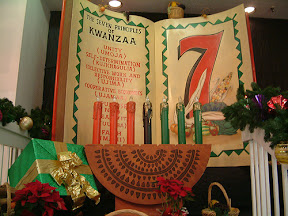
Kwanzaa is also a well-known Holiday in December. Kwanzaa is a weeklong Pan-African Festival taking place December 26th through January 1st. Kwanzaa consist of seven days of celebration including, candle-lighting, pouring of Libations, feasting and gift giving. Families celebrate by decorating their house with objects of art, colorful clothing and fresh fruit. A Kwanzaa ceremony could include drumming and musical selections, libations, and reading of the “African Pledge”, a candle-lighting ritual, artistic performances and a feast called Karamu.

Finally yet importantly is Christmas. Christmas is celebrated December 25 and is a celebration of the birth of Jesus. Christmas is also known as the exchange of gifts among friends and family. Christmas also includes a Christmas tree decorated with lights and ornaments. Other popular holiday plants are holly, poinsettia, mistletoe, and Christmas cactus. A Nativity of Jesus is also included in Christmas and refers to the Christian belief that Messiah was born to the Virgin Mary. The Story of Christmas is based on biblical accounts out of the bible. With some of the most popular Christmas accounts be in Matthew, and Luke. The word Christmas originated from the word Christ’s Mass.

Teaching our children about our families’ culture, heritage and family traditions is so very important. Let us also remember that it is equally important that we should teach them about the different holidays and incorporate some other cultures’ traditions into our own Holiday celebrations.

Encourage your Child to Read

Tuesday, November 13th, 2007

How many times do you grab a good book, pull your child or children into your lap or snuggle on the couch and read to them?  So many of us are guilty of never finding the time, when reading is such an important skill for children to learn, and we as parents have the greatest influence over whether or not they begin to learn or choose to learn to read.  We can encourage them to learn to read by making books and reading an important part of their life from day one.

“Reading aloud with children is known to be the single most important activity for building the knowledge and skills they will eventually require for learning to read.”
—    Marilyn Jager Adams

Reading offers so many valuable things to children.  Here are just a few:

1.    Reading is entertaining.  Do you think they always had cable television wired to most every house in America, well of course not?  Great literature was a popular concept many years ago, much more so than it is today and reading was a favorite past time of almost everyone.  Why not make that the case for your child by starting them out reading at an early age and continuing to encourage them to read over the span of their childhood.

2.    Reading encourages learning.  Reading to your child encourages them to want to learn and gives them the opportunity to have their curiosity stirred by new ideas and concept, such as how people live differently in different places, how things are made, or where things came from, so many questions can be formed in the mind of a child as you read to them.  Thus encouraging them to dig in and find out more!  This of course helps them to learn new things.

3.    Reading increases your child’s vocabulary.  If you want to ensure that your child begins to talk at the right age, learns to say your name, the names of their family members and even things out in the world, you can help them to do so by reading to them.  Reading to a child begins teaching them and exposing them to a wide vocabulary even as a baby.  Many doctors encourage women to even read to their babies while they are still in their womb.

4.    Reading gives your child knowledge.  Knowledge about the world, people, themselves, everything you can think of, it thousands of ideas, topics, themes and concepts can be found in written form in books, on billboards, on the side of your morning cereal box.  Knowledge is all around us and we consume it by reading it.  Encouraging your child to read allows them to soak up all this knowledge.

Helping Your Children Embrace Diversity

Thursday, November 8th, 2007

Do your kids understand and embrace the ethnic diversity of those around them?  Or, have they never been exposed to other races, cultures and ethnicities enough to even know that there are differences.  Today’s culture lends itself to be a little more open about such differences, and this is a positive turn in our society.

Flip on the television and even on the preschool channel there are a variety of culturally diverse shows including Dora the Explorer, Go Diego Go, Little Bill and even Pinky Dinky Do, whose main character has pink hair.

Allowing your child to watch this variety of shows will show them at an early age that there are many different types of people in our world today.  Pointing out the differences but realizing that these differences do not make one group of people better than or worse than another group of people will help your child to understand and embrace all cultures.

There are also movies out there that can show your children a wide variety of cultural areas and allow them exposure to the different cultures that make up the world.  You can also purchase dolls and clothing that are culturally diverse teaching your children even more about the many cultures that come together in our society.

The United States is becoming more and more of a “melting pot” as so many of were taught in history class years ago today it is becoming a reality.  We want our children to embrace this concept of cultural diversity and be tolerant of people who are different from them.

Pop culture joining the ranks can only help us to teach more effectively.  Allow your children to play with culturally diverse toys so that they can learn to be tolerant and loving to other cultures.  Teach them about their own culture, helping them to understand why culture is important to everyone.

Be tolerant and embrace the cultures who are different from you and your family, your child will almost allows copy what their parent is doing so what how you act towards other ethnicities.  Begin with yourself and then teach your children, soon the world will be made up of one big happy diverse family if we all work together to encourage tolerance and diversity.